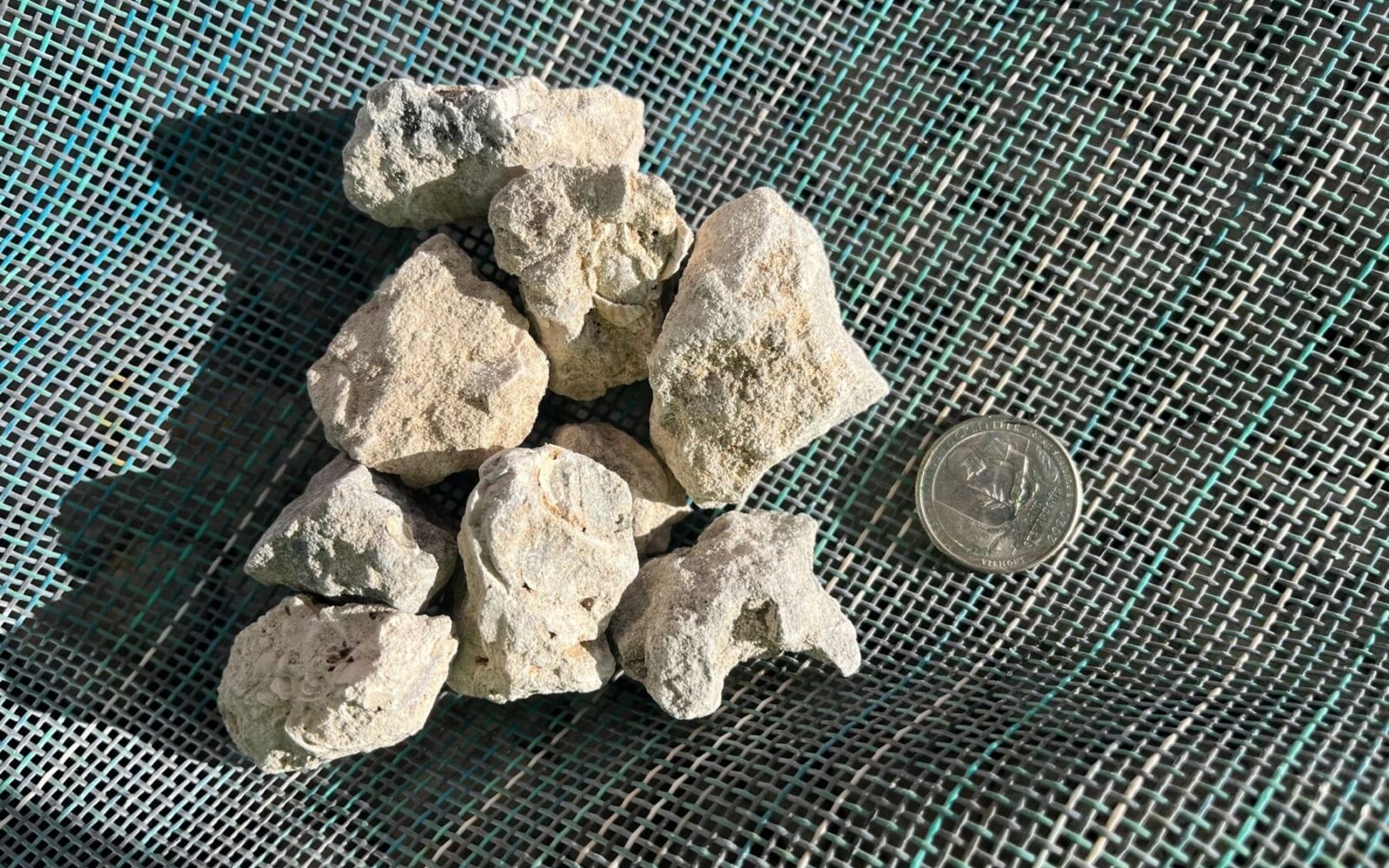
A French drain is a trench with a perforated pipe in it, surrounded by stone, that gives water an easy path from where it collects to somewhere it can go. Almost everything about whether it keeps working comes down to what is packed around that pipe.
Use clean, angular stone
#57 limestone is the usual choice here, and for good reason. It is washed, so it has almost no dust in it, and it is angular, so the pieces hold each other apart instead of nesting together. Those two things leave permanent gaps between the stones, and those gaps are the drain. Water gets into the trench, through the stone and into the pipe with very little resistance.
Roughly dime to quarter sized pieces are big enough to keep the voids open and small enough to place and rake in a trench by hand.
What not to put around it
- Base material or screenings. Paver base and similar products are designed to compact into a dense layer. That is exactly right under pavers and exactly wrong in a drain, because it seals the voids shut.
- Sand. It migrates into the gaps and moves with water. Over time it packs around the pipe.
- Native soil backfill against the pipe. Fines wash in, silt collects in the perforations and flow drops off within a season or two.
- Rounded pea gravel as the main stone. It works far better than sand, but rounded pieces nest more tightly than angular ones and give you less void space for the same volume.
Where fabric belongs
Fabric in a French drain is there to keep soil out of the stone, not to keep water out. Wrapping the trench, with the fabric between the soil and the stone and lapped over the top before the final cover goes on, keeps the sand around it from filtering into the voids. That is the difference between a drain that still runs in ten years and one that silts up.
Fabric wrapped tightly around the pipe alone (“sock pipe”) is a different thing. It is convenient, and in clean sandy conditions it can be fine, but if it blinds over with silt the pipe is finished and you cannot clean it. Where we can, we prefer the fabric on the outside of the stone.
Depth, slope and the outlet
Three things decide whether the trench does anything:
- Depth: deep enough to collect water below where it sits, not just at the surface.
- Slope: a consistent fall along the pipe toward the outlet. On the flat lots around Fort Myers this is the hard part, and it is usually what limits the design.
- The outlet: somewhere legal and sensible for the water to leave. A drain that ends nowhere is a buried holding tank. Discharge to a swale, a lower part of the property, or a permitted point, never onto a neighbor.
What it looks like on top
You can finish a French drain in stone so it keeps taking surface water straight down, or cover it with soil and sod so it disappears. Stone on top collects more debris and needs occasional clearing. Sod on top looks better and relies on water reaching the trench from the sides and below, which is fine when the drain sits at the low point.
One honest caveat
A French drain is a good answer when water has somewhere to go and a bad answer when it does not. On very flat lots, or where the whole yard sits low, regrading or a swale often does more than a trench full of stone, and sometimes the real answer is a combination. That is why we look at the site rather than quoting a length of pipe over the phone.
If you are planning one, our drainage page covers how we approach these, and the material calculator will turn your trench dimensions into cubic yards of stone. Related reading: why water collects next to a lanai.