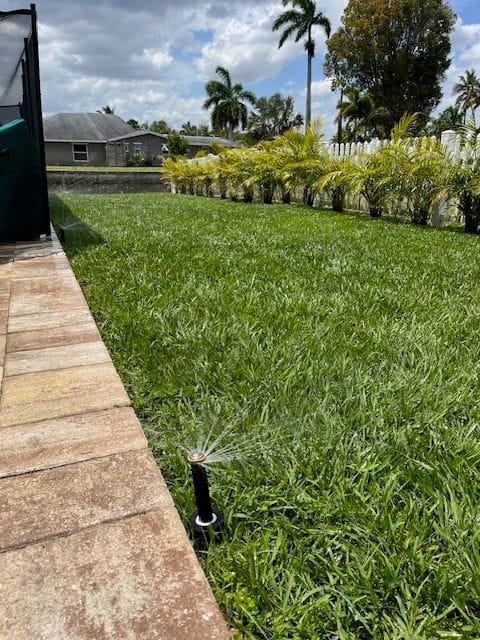
Most yards around Fort Myers were plumbed with spray heads everywhere, including the beds. It works, but it is rarely the best way to water a planting bed here, and it is a common reason beds stay too wet in the rainy season while plants still look thirsty in the dry one.
The short version
- Spray irrigation throws water through the air over an area. It is the right tool for turf, where you want even coverage across a whole zone.
- Drip irrigation delivers water slowly at soil level through tubing with emitters. It is the right tool for beds, hedges, planters and anything mulched.
Why drip suits beds in this climate
Sandy soil drains fast, so water applied quickly runs past the root zone before the plant can use it. Drip applies water slowly enough that the soil has time to take it up, close to where the roots actually are.
It also keeps water off the leaves. In a humid climate, foliage that stays wet overnight invites fungal problems, and constant overspray on a fence, wall or window leaves mineral staining. Drip keeps water where it does work and off everything else.
And it does not fight the planting. As a hedge fills in, spray heads end up watering the back of the hedge instead of the ground. Drip line runs along the plants and keeps working as they grow.
Where spray still wins
Turf. Grass is a continuous surface with shallow roots, and spray covers it evenly. Large open areas are simpler and cheaper to cover with rotors or sprays than with drip tubing. Spray is also easier to inspect: you can stand and watch a zone run and immediately see what is broken.
What people find out after switching beds to drip
- Run times change. Drip runs longer than spray for the same amount of water. A drip zone timed like a spray zone waters far less than the owner thinks.
- You have to look at it. Drip hides under mulch and does its job quietly, which also means a cut line or a clogged emitter can go unnoticed for weeks. A short seasonal check matters more than it does with spray.
- Filtration and pressure matter. Drip works at lower pressure than spray and needs a filter, particularly on well water. That is a different setup at the zone valve, not just different tubing.
- Zones should not be mixed. Turf and beds on one zone forces a compromise on run time that suits neither. Separating them is often the real improvement.
Rainy season versus dry season
From roughly June through September, afternoon storms do much of the watering. The mistake is leaving the controller on its dry-season schedule through it, which keeps beds saturated and wastes water. From the dry months onward the opposite is true, and beds on spray often dry out between cycles because water never reaches deep enough.
A working rain sensor and a seasonal schedule change do more for plant health here than adding zones. Lee County and local utilities also set watering-day restrictions, and those change from time to time, so check the current rules for your address rather than relying on what a neighbor does.
A realistic upgrade path
You rarely need to replace a whole system. On most properties the useful sequence is: check what is actually there and what each zone covers, separate beds from turf where they share a zone, convert the bed zones to drip, then set seasonal run times for each. That can be done one zone at a time as budget allows.
If your beds are on spray heads and you are not sure what you have, an irrigation check is the place to start: we run each zone, see what it covers and tell you what is worth changing. Related reading: low-water landscaping in SWFL.